How to Set a Marketing Budget for a Small Business
“How much should I spend on marketing?” is one of the most common questions small business owners ask, and one of the hardest to answer. Spend too little and nobody hears about you. Spend too much on the wrong things and you lose money you cannot afford to lose. Many owners end up spending randomly: a boosted post here, a flyer there, with no idea what actually worked.
A simple marketing budget solves this. It tells you how much to spend each month, where to spend it and how to know whether it is working. In this guide you will learn three practical ways to set your budget, how to split it between channels, which numbers to track and how to adjust your spending every month.
Why you need a marketing budget
- Control. You decide in advance what you can afford, instead of reacting to every sales call or ad offer.
- Consistency. Marketing works best when it runs steadily, not in random bursts when sales are slow.
- Learning. When you plan and track spending, you discover which channels bring customers and which do not.
- Better decisions. Clear numbers make it easier to grow what works and stop what does not.
A budget is part of a bigger plan. If you have not defined your goals and target customers yet, start with our simple marketing plan for small businesses.
Step 1: Know your numbers first
Before choosing an amount, collect a few basic figures. Rough estimates are fine to begin with:
- Average monthly revenue over the last few months.
- Average order or customer value: how much a typical customer spends with you.
- Profit margin: how much of each sale is left after the cost of the product or service.
- Customer lifetime value: if customers come back, roughly how much they spend over a year or more.
- Your goal: for example, 20 new customers per month or a 15% increase in sales.
These numbers tell you how much you can afford to pay to win one customer. A business with high margins and loyal repeat customers can usually spend more per new customer than a business with low margins and one-time buyers.
Step 2: Choose a budgeting method
Method 1: A percentage of revenue
Set aside a fixed share of your monthly revenue for marketing. Many small businesses use a single-digit percentage as a starting point, and businesses in a growth phase or a competitive market often choose more. The right figure depends on your margins, industry and goals. This method is simple and keeps spending in line with what the business can afford.
Method 2: Work backwards from your goal
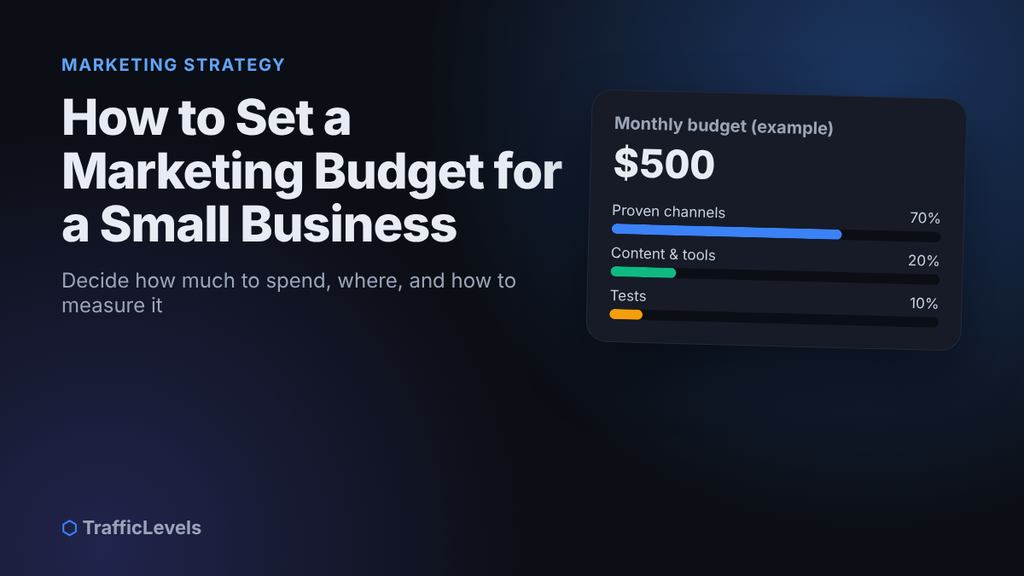
Start with how many new customers you want and multiply by what it typically costs you to win one. For example, if you want 20 new customers and each costs around $25 to acquire, you need about $500 a month. This method connects your budget directly to results, but it requires some data about your acquisition cost. If you do not have it yet, use your first few months to find out.
Method 3: A fixed test budget
If you are just starting and have no data, choose a small fixed amount you can comfortably afford to learn with, run it for two or three months and then review. The goal of this phase is learning, not perfect results.
Many businesses combine methods: they start with a test budget, measure their acquisition cost and then switch to a goal-based budget once they know their numbers.
Step 3: Split your budget wisely
A simple and practical rule is the 70 / 20 / 10 split:
- About 70% on proven channels: the activities that already bring customers, such as paid ads that perform, local search visibility or email marketing to existing customers.
- About 20% on content and tools: photos, short videos, design, copywriting, email software and scheduling tools that support every channel.
- About 10% on experiments: testing a new platform, ad format, audience or offer. Most tests will not become winners, but the ones that do can grow your business.
If you have no proven channel yet, flip the logic: spend more on testing two or three channels until one clearly works. Our guides on TikTok ads vs. organic growth and your first Facebook ads campaign can help you choose where to start.
Step 4: Do not forget free and low-cost marketing
Some of the most effective activities cost time rather than money:
- a complete Google Business Profile and regular customer reviews,
- helpful blog posts that bring visitors from Google,
- consistent organic posts on one or two social platforms,
- email newsletters to customers who already know you,
- partnerships with nearby businesses and word-of-mouth referrals.
Count the time you spend on these, too. If you value your own time, paying for help with some tasks may be cheaper than doing everything yourself.
Step 5: Track the numbers that matter
- CAC (customer acquisition cost) = marketing spend ÷ number of new customers. This tells you how much you pay, on average, to win one customer.
- ROAS (return on ad spend) = revenue from ads ÷ ad spend. A ROAS of 4 means every $1 spent on ads brought $4 in sales.
- ROI (return on investment) = (profit from sales − marketing cost) ÷ marketing cost × 100. Use profit, not total revenue, to see whether marketing truly makes money.
To measure these, you need to know where customers come from. Use UTM links for every campaign, ask new customers how they found you and use discount codes that are unique to each channel.
Step 6: Review and adjust every month
- Compare spending with results for each channel.
- Move money towards what works. If one channel brings customers at a lower cost, increase it gradually.
- Fix or stop what does not. Give new channels a fair test period, but do not keep funding something that clearly fails.
- Plan for seasons. Spend more before your busy periods, such as holidays, back-to-school or Ramadan, and less when demand is naturally low.
Common budgeting mistakes
- Spending only when sales drop. Marketing takes time to work; cutting it completely often makes slow periods longer.
- Judging by likes and views instead of enquiries and sales.
- Spreading a small budget across too many channels, so none gets enough to work.
- Not tracking where customers come from. Without tracking, every decision is a guess.
- Paying for fake followers or views. It wastes money and damages your real reach. We explain why in this article.
Marketing budget checklist
Plan: know your margins and goals, choose a budgeting method, split your budget roughly 70 / 20 / 10 and set a monthly limit.
Track: tag your links, calculate CAC and ROAS, review results every month and move money to what works.
Frequently asked questions
How much should a new business spend on marketing?
There is no single correct number. Start with an amount you can afford to lose while learning, run it consistently for a few months and track the cost of each new customer. Then increase spending on the channels that prove profitable.
Is paid advertising necessary?
Not always. Many local businesses grow mainly through Google Business Profile, reviews, referrals and organic social media. Paid ads can speed things up, especially once you know your numbers.
What is a good customer acquisition cost?
A good CAC is one that is clearly lower than the profit a customer brings you over time. If customers return often, you can afford a higher acquisition cost than a business with one-time buyers.
How often should I change my budget?
Review it monthly and make small adjustments. Make bigger changes quarterly, after you have enough data to see clear trends.
Summary
A good marketing budget starts with your own numbers: revenue, margins and goals. Choose a method, either a percentage of revenue, working backwards from a goal or a test budget, then split your spending between proven channels, content and experiments. Track CAC, ROAS and ROI, review every month and keep moving money to what brings real customers. Small, consistent and measured beats big and random every time.
Want help planning and running campaigns within your budget? Compare our packages, from $10 test campaigns to full monthly growth plans, or contact us for advice.
Want help growing faster?
Tell us about your channel, page or website and we'll suggest the right package.
See Packages Ask on TelegramKeep reading
Best Ways to Make Money From Home: Real Options That Actually Pay
In 2024, 13.3% of people in the United States worked from home, but the best income path still depends on how you want to work. If…
Read more →Affiliate Marketing Platform Case Study: Growing Sales
A business with a solid offer can still struggle to reach new customers consistently, and an affiliate marketing platform may offer a way to build that…
Read more →